America turns 250. What do I do with the Fourth of July?
When I found out that every Black child in my son’s class had been quietly enrolled in an anger management curriculum, I did the math. Three Black kids. Zero explanation.
His teacher flagged him. The school counselor enrolled him. Neither could give me a coherent justification for how they had arrived at this decision. The program was framed gently, as these things always are. “Handling frustration,” they called it. But I looked into it. My son is not an angry child. He is a Black child in America, and apparently, that was enough.
And then, as I was sitting with that, I read the headline: “Supreme Court hollows out a landmark law that had protected minority voting rights for six decades.” A decision that, for me as a Black immigrant woman, underscores just how complicated it is to celebrate a democracy that is still being contested in real time.
Someone asked me recently how I feel about America turning 250. They were waiting for gratitude, I think. After all, I am an immigrant.
I did choose this country. And it is complicated.
I came from Zimbabwe, a nation that knows something about the distance between founding ideals and lived reality. Zimbabwe declared independence. It wrote a constitution. It promised freedom. I grew up watching what happens when a country’s rhetoric and its truth diverge — when liberation becomes a word that applies to some and not others. I did not arrive in America naïve about nations and their myths.
My work at Public Rights Project has kept me close to exactly this divergence. In recent months, we fought Supreme Court cases at the heart of what America’s 250-year-old promise actually means — who is a citizen, who gets to fully participate in our democracy, whether we believe all people deserve safety regardless of where they were born. The answers came back in headlines:
“Supreme Court hollows out a landmark law that had protected minority voting rights for six decades.”
“The Supreme Court ruled. Haitian and Syrian lives changed immediately.”
“Supreme Court upholds birthright citizenship on constitutional grounds.”
So when I watch the fireworks this summer, I will hold two things at once. I will hold the genuine beauty of the idea — that all people are created equal, that rights are not granted by rulers but inherent to being human. It is a remarkable idea. It is still worth believing in. And I will hold, in the same hands, the knowledge that on July 4, 1776, people who looked like me were property. That the man who wrote “all men are created equal” enslaved over 600 human beings across his lifetime. That the liberty being celebrated that day was not mine.
At 250, America is not that country — not entirely. And it has not yet become the country it declared itself to be — not entirely. That in-between is where I live. Where my sons are growing up.
Being a Black immigrant woman in America means carrying a layered kind of belonging. I chose this country, which gives me a different relationship to it than those born into it. I am also Black, which means I inherit a history with this land that predates my arrival — a history of people who built it, bled for it, and were denied its promises. My son carries both. He did not choose any of it. He is just a child, trying to learn, trying to grow, trying to be seen clearly by the adults responsible for him.
They did not see him clearly.
To be sure, I know there are teachers and counselors who show up every day with genuine care for every child in their classroom. I do not believe every institution is irredeemably broken. But good intentions have never been sufficient protection for Black children in America — and at 250, this country should know better than to still be relying on them.
And I understand why some hear this kind of critique as an attack on America. It is not. It is the opposite. You only hold something accountable if you believe it is capable of better. I would not waste words on a country I had given up on.
In 1852, Frederick Douglass asked what the Fourth of July meant to the enslaved. It is a question that still echoes — not as ancient history, but as something I felt sitting across from the adults who could not explain why they had singled out every Black child in the room. Douglass did not give up on America. He spent his life holding it to account because he believed the promise was real enough to fight for.
I understand that now in a way I could not have before I became a mother in this country.
That is how I feel about the Fourth of July. Not with uncomplicated pride. Not with cynicism. With something harder and more durable than either — the stubborn belief that a country 250 years into its experiment is still early enough to get this right, and the clear-eyed recognition that in a classroom not far from here, it is still getting it wrong.
At 250, America doesn’t need more celebration. It needs more people willing to hold it to its own word — in courtrooms, in classrooms, and in conversations when someone asks how we feel about the Fourth of July. That is the work. That is what loving this country actually looks like.
And that is why I am committed to the mission of Public Rights Project, where we stand alongside local governments and leaders carrying forward a centuries-long effort to make this country more inclusive, more equitable, and more faithful to its highest ideals. America’s story is up to us all to write and get right.
The fireworks are beautiful. My son deserves better. Both things are true.
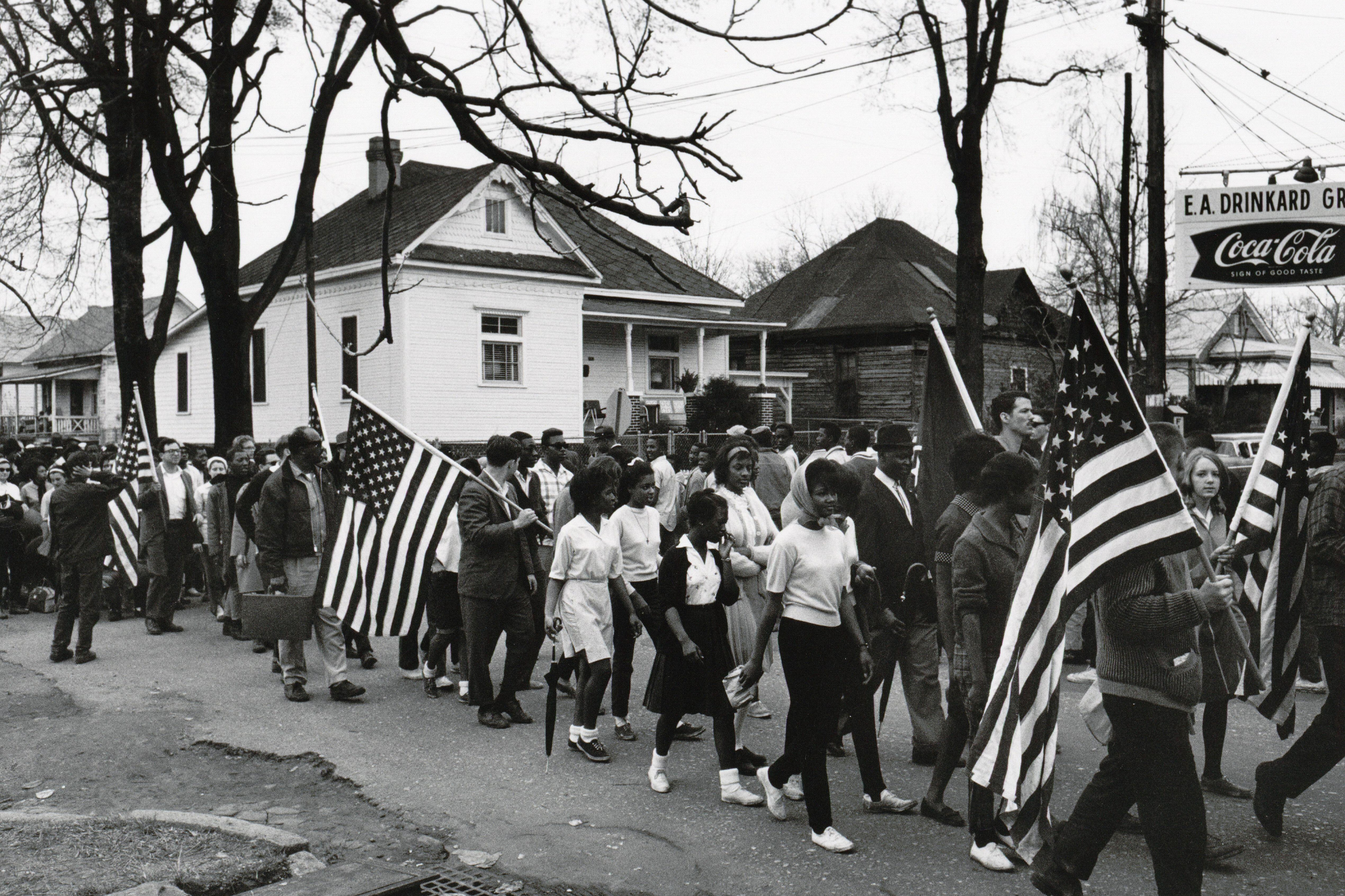
Featured photo: Participants in the civil rights march from Selma to Montgomery, Alabama in 1965.
-
 Blog10/15/2026
A sheriff tried to put an election on trial. The California Supreme Court said no
The request came from Attorney General Rob Bonta, whose office wanted time to review the…
-
Blog9/28/2026
Meet our Election Protection Hub director!
Jenny Holmes’ career has been focused on making life more fair and affordable for historically…
-
Blog9/25/2026
Federal officials deleted Signal messages to cover their tracks. Thanks to our lawsuit, they didn’t get away with it
When we went to court to stop the administration from dismantling federal agencies, we knew…